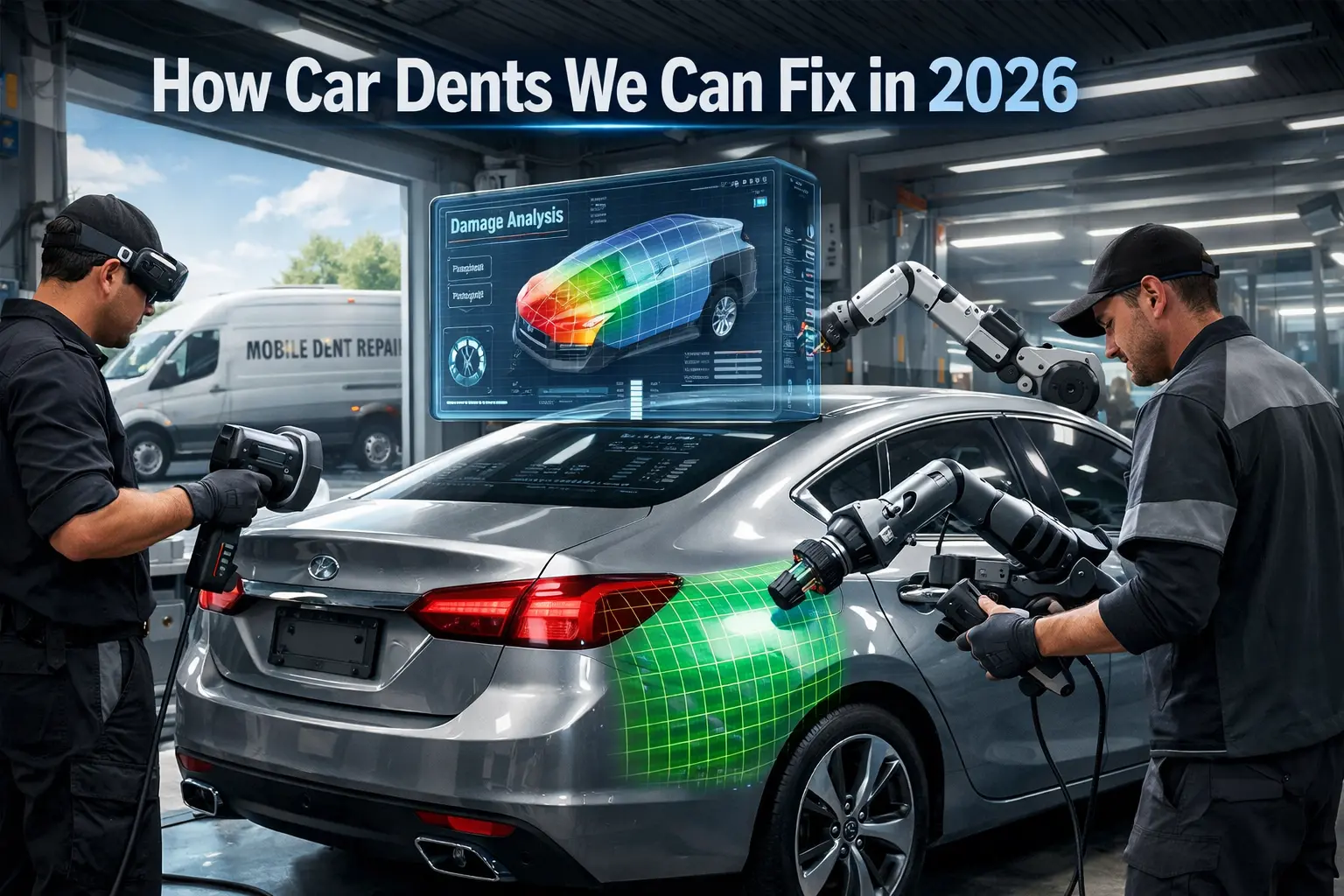
In 2026, the way we fix dents in cars has evolved dramatically from the traditional hammer and dolly methods of the past. Advances in technology, materials science, automation, and mobility of service are reshaping the automotive repair industry. Whether it’s a minor door ding from a tight parking spot or a large crease from a low-speed collision, the approach to restoring vehicle surfaces is more efficient, precise, and accessible than ever before.
This article explores the landscape of dent repair in 2026: the techniques, technologies, business models, sustainability impacts, costs, consumer trends, and what vehicle owners need to know to get the best results in today’s market.
1. The Evolution of Dent Repair: A Brief History
Dent repair has come a long way since the early days of automotive maintenance. For decades, technicians relied on basic mechanical tools—hammers, dollies, and body filler—to reshape metal. While effective, these methods were time-consuming and often sacrificed precision for speed.
In the late 20th century, Paintless Dent Repair (PDR) revolutionized the industry for minor dents. PDR uses specialized tools to gently massage the metal back into shape without disturbing the paint. This not only preserved the original finish but reduced repair times.
By the early 2020s, PDR became widespread in collision shops, and mobile PDR services began offering on-site repairs. Fast forward to 2026, and the industry has integrated digital tools, robotics, and innovative materials into both traditional and paintless techniques.
2. What Types of Dents Can Be Fixed in 2026?
a) Minor Dents (Dings and Small Creases)
These are the most common dents—usually caused by parking lot mishaps, hail, or low-impact bumps. These can often be fixed using:
- Advanced Paintless Dent Repair (PDR)
- Thermo-mechanical reshaping
- Localized heating tools
With the help of digital mapping, technicians can now visualize the dent beneath the paint layer, allowing precise application of counter-pressure to restore the original panel shape.
b) Moderate Dents (Deeper Creases)
Moderate dents that slightly distort the panel line or involve sharper creases may still be addressed with PDR, but increasingly rely on hybrid strategies:
- Heat-assisted PDR
- Flexible mechanical assist tools
- Localized body-panel shaping with intelligent feedback systems
In 2026, technicians can scan the damaged panel and receive real-time guidance from AI software on tool positioning and force application.
c) Severe Dents (Large Distortions)
For larger dents, especially those affecting structural elements or body seams, the repair may involve:
- Robotic shaping
- High-precision pulling systems
- Panel replacement where necessary
Although these are more complex and require time, advancements in robotic assist and 3D-printed support fixtures have significantly reduced turnaround times.
3. Cutting-Edge Technologies in Dent Repair
AI and Digital Surface Mapping
One of the biggest breakthroughs entering mainstream use by 2026 is AI-assisted surface analysis. Technicians scan the damaged panel using handheld or integrated scanners. The AI compares the surface against the vehicle’s original CAD data and calculates the exact distortions.
This gives a precise visualization of the dent’s depth and curvature, far surpassing the old “feel by touch” technique. Vehicle owners see before-and-after digital renderings of the repair plan.
Robot-Assisted Dent Removal
Collision repair shops now use collaborative robots (“cobots”) to assist with heavy-duty metal reshaping. These machines are safe to work alongside human technicians and provide:
- Consistent force application
- Repeatable precision
- Less physical strain on technicians
For deep creases, robots help pull and press panels with calibrated force, guided by digital surface models.
Mobile Dent Repair Units
Mobile service has grown dramatically. Fully equipped vans now dispatch to residential or work locations. These units include:
- Portable PDR toolkits
- On-board surface scanners
- AI-assisted repair guidance
- Mobile paint booths (for repainting when needed)
Consumers increasingly prefer on-site service over driving to a shop, especially for minor repairs.
Smart Materials
By 2026, some new vehicles use self-healing paint and body panels. These coatings incorporate microcapsules that, when scratched or dented shallowly, release polymers that help smooth the surface.
While this tech is more common on higher-end models, its adoption is spreading rapidly. Self-healing materials don’t eliminate all dents, but they reduce the need for minor bodywork.
4. The Rise of Contactless and Remote Services
The COVID era accelerated remote assistance, and dent repair has followed suit. Today’s services include:
- Remote Visual Inspection: Owners upload photos or 3D scans taken with smartphone apps. AI estimates repair cost and time.
- Virtual Consultations: Technicians review damage with customers via video call.
- Digital Estimates and Scheduling: No need to visit a shop until the appointment.
For simple dents, the entire process—from estimate to payment—can be handled digitally.
5. What’s the Cost in 2026?
Cost depends on dent size, location, vehicle model, and repair technique:
- Small, minor dents: $50–$150 (often handled by mobile PDR)
- Moderate dents: $150–$400 (may involve AI guidance and hybrid methods)
- Severe dents: $400+ (robotic assist, panel replacement if necessary)
While prices have remained competitive, advanced technologies sometimes carry higher upfront costs. However, shops using AI and robotics often deliver faster turnaround and more accurate results, making them cost-effective overall.
6. The Customer Experience: What Has Changed?
Faster Turnaround
Thanks to AI planning and robot assistance, many dent repairs that used to take days are now completed in hours. Mobile service providers can often fix door dings during the workday while the owner is at the office.
Transparent Estimates
Digital estimates powered by imaging and AI reduce uncertainty and disputes over pricing. Customers receive:
- Before/after diagrams
- Damage depth maps
- Breakdowns of labor and parts costs
Quality Assurance Technologies
Shops now use digital quality control tools. After repair, the surface is scanned to verify it matches original geometry within tolerances measured in fractions of a millimeter.
7. Training and Certification for Technicians
With new technologies come new skill requirements. Modern dent repair technicians must know:
- Digital scanning tools
- AI surface analysis
- Robot handling systems
- Advanced PDR and material science basics
Certifications from auto manufacturers and independent bodies now include digital tool proficiency.
8. Sustainability and Environmental Impact
Vehicle repair has also become greener:
- Paintless Dent Repair (PDR) minimizes the use of filler and repainting, reducing volatile organic compound (VOC) emissions.
- On-site mobile repairs cut fuel consumption from customer trips.
- Recycled materials are increasingly used in replacement panels.
- Smart materials reduce the need for traditional bodywork.
In many regions, repair facilities are required to meet strict environmental standards, pushing adoption of sustainable techniques.
9. Insurance and Dent Repair in 2026
Insurance companies increasingly partner with dent repair networks. Some key trends:
- Direct billing systems
- AI damage verification for faster claims
- Telematics data to assess impact forces and pre-accident conditions
Customers can sometimes settle claims without visiting an adjuster in person.
10. Challenges and Limitations
Despite the advances, some challenges remain:
- Severe structural damage still requires traditional body shop work.
- Cost of high-end technologies can be prohibitive for smaller shops.
- Training gaps as older technicians adapt to digital systems.
- Compatibility issues with certain vehicle makes and models.
Nevertheless, ongoing innovation continues to address these pain points.
11. The Future: What Comes Next?
Looking beyond 2026, we can anticipate:
- Augmented Reality (AR) repair overlays for technicians
- Fully autonomous robot repair bays
- Smart vehicles that self-diagnose and self-correct minor dents
- Blockchain-verified repair histories for vehicle resale transparency
The repair process will become even more integrated with digital vehicle ecosystems.
Conclusion
Dent repair in 2026 is more precise, efficient, digital, and customer-centric than ever before. The blend of AI, robotics, mobile services, and smart materials has transformed an age-old industry. Whether you’re a car owner wanting a quick fix for a minor dent or someone interested in the future of automotive repair, 2026 offers a glimpse into a world where technology and craftsmanship work hand-in-hand to restore vehicles with unmatched accuracy.